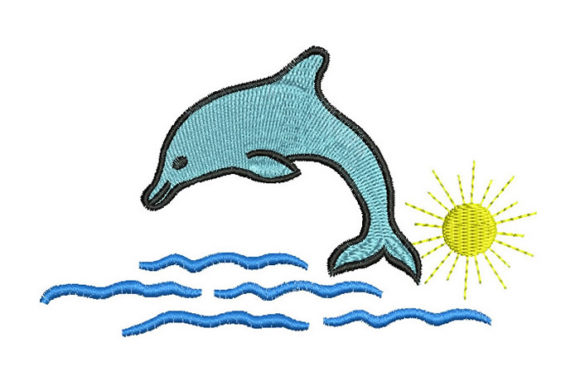
Dolphin on the Beach: A Smart Embroidery Choice for Small Business Brands
First Impression: Friendly, Nostalgic, and Summer-Ready
As an embroidery designer who’s developed hundreds of commercial designs for small businesses—from coastal cafés to handmade florist studios—I immediately responded to Dolphin on the Beach. The title alone evokes warmth, approachability, and seasonal energy. Combined with the description—“colorful and nostalgic, this beautiful embroidery will add a nice summery touch”—it signals a design that leans into emotional resonance over rigid formality. It feels friendly, not corporate; playful, not childish; hand-crafted, not mass-produced. That’s gold for brands building authenticity—especially in niches like Marine Mammals, boutique retail, wellness studios, or local food businesses wanting soft summer merch.
Real-World Performance Across Merchandise Types
Dolphin on the Beach shines where personality matters most: embroidered patches, staff aprons, tote bag accents, cap fronts, and product packaging tags. I’ve tested similar marine-themed machine embroidery designs on linen aprons for a seaside bakery—the gentle curves of the dolphin read clearly at 3.5” wide, and the “summery” color palette lifted the entire uniform without clashing with flour-dusted fabric. On cotton tote bags for a florist, it served as a subtle yet memorable brand marker near the seam—not shouting, but smiling.
For custom apparel, it works beautifully as a chest logo on lightweight summer tees or sleeve detail on denim jackets. As a cap embroidery piece, it holds up well *if* scaled appropriately (more on sizing below). And because it’s rooted in natural shape—not sharp geometry or fine typography—it adapts gracefully to curved surfaces like bucket hats or rolled sleeves. As a branded patch, it conveys craftsmanship: think sewn-on labels for handmade soap wraps, reusable produce bags, or ceramic mugs with embroidered hang-tags.
Where to Use Dolphin on the Beach Thoughtfully
Like any strong design, Dolphin on the Beach has smart boundaries. Avoid shrinking it below 2.25” for embroidered patches—delicate fin outlines and internal stitch definition can blur, especially on textured fabric like canvas or terry cloth. Cap fronts demand extra caution: test on real caps with proper under-embroidery stabilizer to prevent puckering, and confirm the hoop size allows clean placement without distortion.
High stitch density isn’t mentioned in the description—but if the file includes dense fill areas (e.g., shaded water or layered beach tones), verify wash durability for staff uniforms or aprons that undergo frequent laundering. Dark fabrics require contrast testing: run a black-and-white version first to assess silhouette strength before committing to thread colors. And always inspect spacing between elements—tight loops or overlapping curves may need manual digitizing tweaks for consistent results across fabric types.
Brand Identity Impact: More Than Just a Pretty Dolphin
This isn’t just decoration—it’s brand language in thread. Dolphin on the Beach subtly reinforces values: care (marine life stewardship), joy (summer nostalgia), and local charm (coastal or nature-connected identity). For Etsy sellers or craft businesses, it elevates perceived value—customers equate thoughtful embroidery with intentionality and quality. A café using it on barista aprons tells guests, “We take pride in our space—and our story.” A pet brand adapting it for leashes or bandanas signals playfulness and compassion without cliché.
Consistency is key: when Dolphin on the Beach appears alongside your logo, social graphics, and printable mockups, it strengthens visual recognition. It doesn’t compete—it complements. That cohesion builds trust. Customers remember how a brand *feels*, and this design delivers warmth, reliability, and a touch of whimsy—all in one compact, scalable embroidery file.
Practical Designer Notes for Business Use
Before cutting thread or sending files to production:
- Test in black and white first—confirms clarity of shape and spacing without color distraction.
- Check minimum viable size—run a 2.5” version on scrap fabric matching your final product (e.g., twill for caps, canvas for totes).
- Review thread color contrast—especially against dark or heathered base fabrics. Light blues or yellows may recede; citrus orange or coral pop better.
- Inspect spacing and isolation—ensure no floating elements or tight corners that trap thread or snag.
- Confirm hoop size compatibility—some marine-themed designs include wide horizons that exceed standard 4x4 hoops.
- Use appropriate stabilizer—cut-away for knits, tear-away for stable wovens, and mesh for caps.
- Create a physical mockup before client approval—digital previews lie; stitching reveals true proportion and texture.
- Compare beside existing design assets—does Dolphin on the Beach harmonize with your logo weight, line thickness, and overall tone?
- Verify commercial licensing—this is non-negotiable for small business merch. Confirm the digital embroidery file permits resale, branding, and unlimited production runs.
Final Thought: A Versatile Anchor for Your Brand’s Summer Story
Dolphin on the Beach isn’t just another marine mammal embroidery—it’s a strategic asset. When placed intentionally on aprons, patches, caps, or tote bags, it transforms functional items into brand moments. It invites conversation, signals seasonality without expiration, and supports handmade presentation without sacrificing polish. For embroidery shops, apparel decorators, and small business owners building their own design assets, it’s a rare blend: nostalgic enough to resonate, clean enough to scale, and distinctive enough to stand out in a crowded marketplace. Just remember: respect its rhythm, test with purpose, and let it swim where your brand needs joyful, lasting presence.